
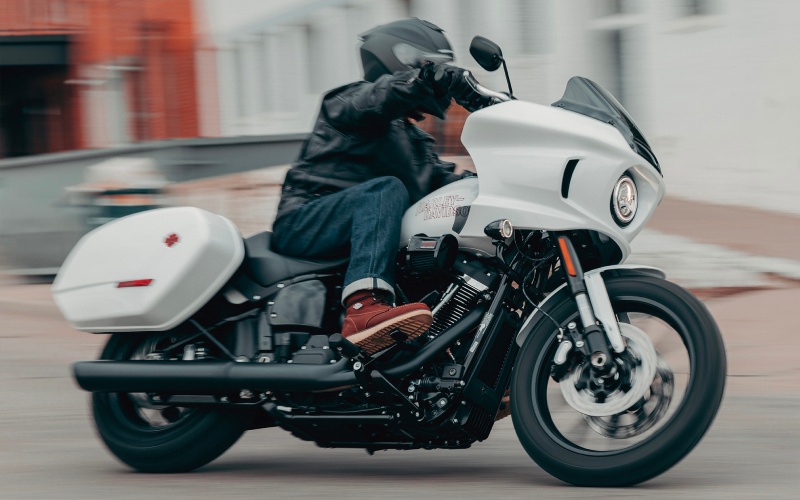
Freedom Valley Harley-Davidson® - Does the FXRT-inspired fairing on the 2026 Harley-Davidson® Low Rider® ST make a real difference around Whitehall Township, PA?
The FXRT-inspired fairing is the first thing most riders notice on the 2026 Low Rider® ST, but what matters more is what you feel behind it. If you spend time on Route 22, I-476, or crosswinds along open Lehigh Valley stretches, the right fairing can turn a good ride into a great one—less buffeting, less fatigue, more focus on the line you want to hold. Let’s unpack how Harley-Davidson® shaped this fairing and why it resonates with riders who balance daily trips with longer weekend routes.
On this platform, the fairing isn’t just style—it’s functional aerodynamics. The leading edge initiates clean airflow, and the sculpted contours guide it around your helmet and shoulders. At speed, that stability helps reduce the micro-corrections you’d otherwise make in gusty conditions and creates a quieter pocket so your senses stay fresher deeper into a ride. The design also frames an All-LED headlamp and signals, giving you bright, uniform illumination that stands out in traffic and on unlit roads, without hot spots or distracting color shifts.
Fairing fundamentals that show up mile after mile
There’s a distinct difference between a fairing that looks right and one that works right. The Low Rider® ST’s FXRT-inspired unit was shaped to keep the rider’s upper body in cleaner air at realistic highway speeds—an especially welcome trait on the long, exposed spans near Whitehall Township where wind can funnel unpredictably. The result is a calmer helmet environment, steadier shoulders, and less physical bracing over time. If you’re aiming to stack miles without sacrificing the bike’s athletic feel, that combination is hard to beat.
Harley-Davidson® pairs the fairing with a chassis that’s willing to hustle: a single-cartridge 43 mm inverted front fork, a hidden free-piston coil-over monoshock with hydraulic preload adjustment, and Michelin® Scorcher 31 tires. When the wind picks up, the aero helps you stay loose on the bars, and the suspension helps you stay precise in the corners.
How it complements the Milwaukee-Eight® 117 High Output
Power delivery matters when the wind is working against you. The Milwaukee-Eight® 117 High Output is all about tractable torque—128 ft-lbs at 4,000 rpm and 114 HP on tap—so the fairing’s stability becomes a multiplier. You get a motor that surges cleanly and a front end that stays composed, allowing you to keep the bike settled on imperfect pavement while still exploiting that midrange. The performance 2-into-1 exhaust and Heavy Breather intake sharpen the response without introducing nervousness at the bars.
Selectable Ride Modes further tighten the equation. When conditions change, you can tune the Low Rider® ST’s behavior to match. Combine that with cruise control for long slogs and you have a fairing-powered comfort boost, tech-enabled consistency, and a powertrain eager to reward an open throttle—all attributes that shine on variable Central and Southeastern PA routes.
Lighting and visibility in real-world conditions
Visibility is part of confidence, and the All-LED lighting suite is a quiet triumph here. The fairing positions the headlamp for an evenly distributed beam, helping your eyes relax on back roads and during late returns from Lansdale or Quakertown. Clear, immediate turn signals make your intentions obvious to surrounding traffic, and the compact packaging keeps the fairing’s lines taut and purposeful.
The 4-inch analog-digital display behind the screen presents critical info—gear, fuel, ride mode, TCS and ABS indicators, TPMS, and more—without clutter. In gusty conditions, the less you fumble for data, the better; placement and legibility matter, and Harley-Davidson® got that right.
When the road throws a curveball
On imperfect pavement or when a passing storm slicks the highway, Rider Safety Enhancements are engineered to help the bike maintain traction and composure. ABS, TCS, and DSCS are there for straight-line surprises, while cornering variants—C-ABS, C-TCS, and C-DSCS—adjust interventions based on lean angle. The fairing’s steadying effect up front pairs naturally with these systems: you sense fewer bar inputs, get more consistent front tire feedback, and can trust the chassis to remain calm when conditions demand it.
For riders who split time between errands and open-road runs, the fairing’s benefits stack up quickly. Short hops to dinner feel calmer, interstate stretches feel more sustainable, and the bike’s West Coast stance never gets old in the garage. If your rides arc across the Lehigh Valley and neighboring corridors, that blend of form and function is easy to appreciate.
Practical ways to tailor your airflow
Fine-tuning is simple, and it makes a difference when your routes vary from neighborhood streets to exposed highway sections.
- Screen height choices: If you’re taller or run a more upright helmet, a windshield extension can raise the air pocket and reduce crown buzz.
- Helmet and jacket pairing: A smooth-shell helmet and snug-collar jacket minimize turbulence inside the fairing’s clean airflow.
- Bar and mirror positioning: Small bar-angle and mirror-height tweaks can change the way air meets your shoulders and gloves.
- Preload adjustments: Setting sag for your weight ensures the fairing sits at its intended angle, preserving the aero pocket.
With a few thoughtful setup steps, you can optimize the Low Rider® ST’s aero to match your height, gear, and typical pace. The fairing gives you the right foundation; your fine-tuning personalizes the result.
Frequently Asked Questions:
Is the FXRT-inspired fairing noisy at highway speeds?
It’s shaped to create a calmer pocket around your head and chest compared to naked cruisers. Helmet choice and screen height affect outcomes, but most riders notice less buffeting and a quieter ride at sustained speeds.
Will taller riders need a different screen?
Some taller riders prefer a low-profile extension to lift airflow above the helmet crown. It’s a quick, reversible change that can dial in comfort on longer highway runs.
Does the fairing add weight that hurts handling?
The Low Rider® ST’s chassis, suspension, and geometry are tuned with the fairing in mind. In practice, the bike feels planted and responsive, with the fairing contributing to stability rather than dulling steering.
How does it perform in crosswinds?
The shape helps keep inputs predictable by channeling air around the rider. You’ll still feel strong gusts, but the steering stays calmer compared to a naked front end, letting the suspension and tires do their job.
The FXRT-inspired fairing isn’t just a throwback nod; it’s a well-considered piece of functional design that elevates the 2026 Low Rider® ST on the roads that define daily and weekend riding around Whitehall Township. If you’re mapping a garage-friendly, high-torque machine that can cover distance without dulling the fun, this fairing belongs near the top of your must-try list. Freedom Valley Harley-Davidson®, serving Whitehall Township, Lansdale, and Quakertown, can help you tailor airflow, ergonomics, and rider tech so the whole package works with your body geometry and your preferred routes. Set up thoughtfully, the fairing becomes less something you notice and more something you rely on—mile after mile.